Alvega-Ortiga
Journeys invariably unsettle me, especially the ones undertaken alone. I am thrilled at the prospect of travel, excited with the anticipation of seeing new places and meeting fresh faces.And if I am forced to stay at one place for a few days at a stretch like it was in Mação, I grow morose and dull. But invariably, the night before the trip panic sets in. And I wish I could stay on where I am and not budge.
Sure enough, after the first half an hour into the trip things are back to normal. But here I am at the beginning of the half an hour pulling my bag across the rails on to the platform of Alvega- Ortiga station on my way to Italy. The mood is enhanced by the wind and the cold. The platform is deserted, there is an eerie silence except for the distant barks of a dog. The moon is so large today that it looks artificial and the platform is bathed in moonlight.
Showing posts with label Winter 2010. Show all posts
Showing posts with label Winter 2010. Show all posts
25 February 2011
24 February 2011
The One- way Street : Part III

At five o' clock it was already dark in Wasserburgh. We, Daniela, Elisa and me wrapped our shawls over our faces against the bitter cold as we walked along the bank of the dark still lake on our way into the town centre. Betty and Bruno walked alongside magically insulated to the cold and feeding us in with tales from the town. Betty told us how one day from inside a shop she heard someone on the street speak in Portuguese in a Brazilian accent that was endearingly familiar to her. And how she rushed out to meet them just as I would in the unlikely event of hearing someone speak in Malayalam on a street in Macao. It was one of the grandson of the Maikafers' who had come in search of his grandfather's story.And Betty joined the search.
12 February 2011
The One- way Street: Part II
(Story of a man who left)
There never is a story of one man alone.There is a family gathered for dinner around a few meager plates, there are friends and beer glasses and the bar man across the counter,there is a sister who has long grown out of pillow fights. And in Franz's story 700 miles further north there was a young woman.
 If Maria loved anything rather more than her fiance it was her homeland. For her that was where life was meant to be. So when Franz left in search of a new world, on board a modest vessel, with a cheap passage which meant he had to work his way through the voyage, Maria was in a struggle of a different sort. In the end she realised she could not choose between the two and set out on the same road herself, resolving to bring back the man she loved to the land she loved.I am rather more in awe for Maria. Over eighty years ago, for a young woman to undertake such a journey, required something more than ordinary will.
There never is a story of one man alone.There is a family gathered for dinner around a few meager plates, there are friends and beer glasses and the bar man across the counter,there is a sister who has long grown out of pillow fights. And in Franz's story 700 miles further north there was a young woman.
If Maria loved anything rather more than her fiance it was her homeland. For her that was where life was meant to be. So when Franz left in search of a new world, on board a modest vessel, with a cheap passage which meant he had to work his way through the voyage, Maria was in a struggle of a different sort. In the end she realised she could not choose between the two and set out on the same road herself, resolving to bring back the man she loved to the land she loved.I am rather more in awe for Maria. Over eighty years ago, for a young woman to undertake such a journey, required something more than ordinary will.
03 February 2011
The One- way Street: Part I
 (Story of a man who left)
The time was the 1920 s. There lived in the Bavarian town of Wasserburgh a young man named Franz Maikäfer. Franz strongly disliked his surname; for, Maikäfer was the name of a bug. Its picture was drawn into the red walls of his modest house in the heart of Wasserburgh. But the name was at the time the last of Franz's worries.
Post World war I, Germany was plunged into a deep economic crisis . The nation experienced hyperinflation in 1923 and chronic high unemployment throughout the 1920's.The death knell of the Weimar republic was ringing. And, Franz could hear it from the first floor window of his family house in the quiet town. I imagine him sitting with his unemployed friends in a pub downtown, where they met each evening,worry lining their prematurely old faces. One evening, banging his fist on the wooden counter in frustration Franz shouted "I need to get out".
27 January 2011
Beering in Bavaria: Part II
In the second decade of 17th century, Europe was caught up in a series of wars.Faith, territory...the reasons were manifold.Like a curse unleashed it spread over Europe, one war leading to another and that to another. Half way down the mad lane, young Gustavus Adolfus of Sweden, 'the Lion of the North',invaded Bavaria. In the face of imminent plunder and loot, the Bavarians sought for settlement. And the accord was reached, the city left in peace, for 600,000 barrels of Hofbräuhaus beer.
The Hofbräuhaus am Platzl, was where we stopped next.The Hofbräuhaus is state owned and was founded in 1589 by the Duke of Bavaria. Over the years its brew has passed through many a famous and infamous lips. There was Mozart and Lenin; but also there was Hitler (although they say he never drank the beer).The huge public beer hall can seat over a thousand guests.So we sat down, waiting for our beers and thumping on the table to the rhythm of the dance performance onstage.
Half way down the mad lane, young Gustavus Adolfus of Sweden, 'the Lion of the North',invaded Bavaria. In the face of imminent plunder and loot, the Bavarians sought for settlement. And the accord was reached, the city left in peace, for 600,000 barrels of Hofbräuhaus beer.The Hofbräuhaus am Platzl, was where we stopped next.The Hofbräuhaus is state owned and was founded in 1589 by the Duke of Bavaria. Over the years its brew has passed through many a famous and infamous lips. There was Mozart and Lenin; but also there was Hitler (although they say he never drank the beer).The huge public beer hall can seat over a thousand guests.So we sat down, waiting for our beers and thumping on the table to the rhythm of the dance performance onstage.
12 January 2011
Beering in Bavaria: Part I
 I flew to Munich amidst fears of blizzards and airport closures.The television screens of my Air Berlin flight played in unison, Sting's "Rise and fall" which was not exactly reassuring.But all went well. Daniela picked me up at the Munich Hauptbahnof(Central station). Along our short walk to the hostel, I realised a few things. One was that snow was beautiful. Second, that it is not always cotton soft and fluffy, but is wet and crystalline as well. Third, and a few more steps down the lane, that when the temperature is in the negative, the chill creeps in through your fingers and your nose and freeze your insides.
So bless Dani for taking me a few minutes into my arrival to the warmth of the little underground pub of our "4 u München" hostel and introducing me to the magics of German Weißbier.Weißbiers are wheat beers which mix at least fifty percent wheat into barley malt achieving a light golden brown coloured smoothness. That half litre glass was the first among many such that guided our two days in Munich.
07 January 2011
Immaculate Conception
I will start from the very end of our trip. Dani and me reached Porto yesterday around midnight.From Zurich we flew to Palma de Mallorca from Palma de Mallorca to Barcelona and finally from Barcelona to Porto.So why did we take this strange angular route almost tracing a 'V'in the air, covering a lot of useless nautical miles, hoping off and on at airports? Well that is how it is when you have to fly cheap.
So after over eight hours of wait at the Barcelona airport, we moved to the Ryan air counter. To be fair, Ryan air offers the cheapest flight options within Europe. But then its like a hurdles race where any time you might trip over of a thousand carefully set rules of law. You fall down and end up paying through your nose.
So after over eight hours of wait at the Barcelona airport, we moved to the Ryan air counter. To be fair, Ryan air offers the cheapest flight options within Europe. But then its like a hurdles race where any time you might trip over of a thousand carefully set rules of law. You fall down and end up paying through your nose.
05 January 2011
Snow-ward bound...
I had never known snow. For me it was settled on the picture post card roof-tops and trees.Snow was the cotton fluffed over plastic Christmas trees behind shop windows.Snow fell onto the pages of the novels I read and melted over poems. But I still had never known snow.So it was mostly to see snow that I was travelling this time. A tour charted out carefully by Daniela, through Bavaria, Vienna and Zurich over which the year would pass and the new one would begin.
The trip began in the Bavarian capital of Munich on a night when the railroads and streets were covered with snow.It ends today in Zurich, where contrary to expectations, the sun shone bright over the city. We never knew any city in depth, but skimmed through their surfaces. Sometimes we strolled aimless along the streets, sometimes went for the strict routes of tour buses. We traveled to the Bavarian interiors, got caught in the Viennese new year. We went into drunken excesses and fell into the temptation of unknown flavours at expensive restaurants.
The trip began in the Bavarian capital of Munich on a night when the railroads and streets were covered with snow.It ends today in Zurich, where contrary to expectations, the sun shone bright over the city. We never knew any city in depth, but skimmed through their surfaces. Sometimes we strolled aimless along the streets, sometimes went for the strict routes of tour buses. We traveled to the Bavarian interiors, got caught in the Viennese new year. We went into drunken excesses and fell into the temptation of unknown flavours at expensive restaurants.
03 January 2011
After the Christmas Eve
1.
There was an incessant downpour all through the Christmas day. The day turned chilly and the breeze blew off the umbrellas from passers-by. All I could do was to just hold on to the handle of my fragile black "made in China" umbrella as I was constantly blown off the course by the winds that the Tagus carried.
One unusual thing about Lisbon is that it announces elevators among its modes of public transport. I was heading to one of them, Elevador Santa Justa. This 45 meter tall iron structure was built in 1902 in the neo-gothic style and connects the streets of the Baixa to the Largo Carmo area. I did not think much of the architecture. But I had to appreciate it for its sheer height. All the more after finding out that the lift was closed for the day. So i climbed all the way up, panting,clutching my sides, my face frozen, as raindrops like pinpricks fell. The view in offer was however worth the effort. So, even with the rain like a curtain caught in wind, blocked my view. The Baixa neighbourhood, the Lisbon castle and the Rossio square lay around and below in a spectacular spread.The spectre of the Igreja do Carmo (Carmo church) destroyed in the 1755 earthquake looms in the background. Its roofs opening out into the sky, gaping in horror at the heavens' wrath. A sombre monument to destruction.
2
 The Castelo dos Mouros (Moorish Castle) is by far the most spectacular structure I have encountered in Portugal.Not many would agree with me there. The country is strewn with vestiges of Manueline architecture. But the sumptuous and heavy Manueline style seems a bit overdone to me.The Castelo dos Mouros is a 9th century structure. Subject to attacks and occupations over the centuries, the castle was renovated in 1830 during the reign of King Ferdinand well in tune with the romantic spirit of the times.
  The Moorish castle at present offers a view that was unintended at the time of its construction, the 19th century Palacio Nacional da Pena. The Palace is a curious mixture of arches and domes ornate windows bringing into mind the Manueline ones.Its rooms are a loud proclamation of luxury. However it is not much in my system to appreciate, the heavy wooden furniture or the silver and gold goblets. I am a claustrophobic being. And once I was inside the long rooms and corridors of the palace, all I wanted to was to get out. However viewed from downhill, in its entirety, the Palace of Pena is a lovely sight.It is painted red and yellow and blue into a fairy tale perfection.
Over the past two days, the soles of my feet were troubling me a lot! I suppose it has to do with my amazing sense of direction, which made me walk over four hours on Christmas night finding my way back to the hostel. So i wound up the the little excursion earlier than I would have otherwise. But not before wandering into the Cafe a Piriquita. The crispy, light crust of the cream filled Traverssario sprinkled with white powdered cane sugar over a cup of strong unsweetened coffee..oh sweet dear life!
There was an incessant downpour all through the Christmas day. The day turned chilly and the breeze blew off the umbrellas from passers-by.
All I could do was to just hold on to the handle of my fragile black "made in China" umbrella as I was constantly blown off the course by the winds that the Tagus carried.One unusual thing about Lisbon is that it announces elevators among its modes of public transport. I was heading to one of them, Elevador Santa Justa. This 45 meter tall iron structure was built in 1902 in the neo-gothic style and connects the streets of the Baixa to the Largo Carmo area. I did not think much of the architecture. But I had to appreciate it for its sheer height.
All the more after finding out that the lift was closed for the day. So i climbed all the way up, panting,clutching my sides, my face frozen, as raindrops like pinpricks fell. The view in offer was however worth the effort. So, even with the rain like a curtain caught in wind, blocked my view. The Baixa neighbourhood, the Lisbon castle and the Rossio square lay around and below in a spectacular spread.The spectre of the Igreja do Carmo (Carmo church) destroyed in the 1755 earthquake looms in the background. Its roofs opening out into the sky, gaping in horror at the heavens' wrath. A sombre monument to destruction.2
Bless the sun for shining on Sintra this day. For, I was not prepared to take in another days of shivering long walks.So, the day after Christmas i took my train to the famed Sintra.Sintra lies about half an hour off to Lisbon towards its North- West and is one of the most known tourist destination from Portugal. I spend my day wandering in Leisure through its historical centre, among the towers of the Castelo dos Mouros and through the corridors of the Pena palace.Lo! Cintra's glorious Eden intervenes
In variegated maze of mount and glen.
Ah me! what hand can pencil guide, or pen,
To follow half on which the eye dilates
- Lord Byron
The Castelo dos Mouros (Moorish Castle) is by far the most spectacular structure I have encountered in Portugal.Not many would agree with me there. The country is strewn with vestiges of Manueline architecture. But the sumptuous and heavy Manueline style seems a bit overdone to me.The Castelo dos Mouros is a 9th century structure. Subject to attacks and occupations over the centuries, the castle was renovated in 1830 during the reign of King Ferdinand well in tune with the romantic spirit of the times. The Moorish castle at present offers a view that was unintended at the time of its construction, the 19th century Palacio Nacional da Pena. The Palace is a curious mixture of arches and domes ornate windows bringing into mind the Manueline ones.Its rooms are a loud proclamation of luxury. However it is not much in my system to appreciate, the heavy wooden furniture or the silver and gold goblets. I am a claustrophobic being. And once I was inside the long rooms and corridors of the palace, all I wanted to was to get out. However viewed from downhill, in its entirety, the Palace of Pena is a lovely sight.It is painted red and yellow and blue into a fairy tale perfection.Over the past two days, the soles of my feet were troubling me a lot! I suppose it
has to do with my amazing sense of direction, which made me walk over four hours on Christmas night finding my way back to the hostel. So i wound up the the little excursion earlier than I would have otherwise. But not before wandering into the Cafe a Piriquita. The crispy, light crust of the cream filled Traverssario sprinkled with white powdered cane sugar over a cup of strong unsweetened coffee..oh sweet dear life!
26 December 2010
The 11:30 shots
(Lisboa)
So I walk back to my hostel on the Christmas Eve. I stop for a moment at the Praça do Comércio. The square is flanked by two symmetrical buildings that angles out to the Tagus in an open- armed embrace. To the centre of the square is the equestrian statue of King José I.
At 9:30, on the 1st of November, 1755, Lisbon was hit by a huge earth quake. Known hence as the ‘Great Lisbon Earthquake’ it changed the face of the city in about ten minutes. Soon after the earthquake fires broke out. And what was once the royal palace was now rubble and ash. It was on these ruins that the Praça do Comércio was built, as conceived by the architect Eugénio dos Santos and as encompassed within the rebuilding efforts of the prime Minister of José I, Marquis de Pombal
Tonight the square is illuminated in anticipation of Christmas. In fact my whole walkway is lit by the gold and silver bulbs that hangs overhead like huge luminous water drops. But like the roads, the Praça is also deserted. The silence is slowly getting on to me. I think of the Christmases back home and all I want is to get back to some noise.
 So I walk back to the hostel for my Christmas dinner.I know I am missing home...
Once inside the 'yes' hostel, the mood changes. This is undoubtedly the best hostel experience I have had. The place is as warm as the staff here is. I eat and drink my way through the courses of my Christmas dinner. I have at my table republicans and democrats. The venerable lady next to me is in search of the perfect place to write her book. Shirley talks about how her Sri Lankan origins could well be traced back to Portugal. I walk in the drizzle with Antonio and Stephanie and Johny to the Rossio square and wonder aloud why Lisbon chose to remain indoors.
And strangers gather around the counter with their shot glasses to drain it in a single moment of unison. I know there is something about the “jingle bells”. But the clang of our shot glasses as we slam them back to the counter is just as good as the carol ever gets!
So I walk back to my hostel on the Christmas Eve. I stop for a moment at the Praça do Comércio. The square is flanked by two symmetrical buildings that angles out to the Tagus in an open- armed embrace. To the centre of the square is the equestrian statue of King José I.
At 9:30, on the 1st of November, 1755, Lisbon was hit by a huge earth quake. Known hence as the ‘Great Lisbon Earthquake’ it changed the face of the city in about ten minutes. Soon after the earthquake fires broke out. And what was once the royal palace was now rubble and ash. It was on these ruins that the Praça do Comércio was built, as conceived by the architect Eugénio dos Santos and as encompassed within the rebuilding efforts of the prime Minister of José I, Marquis de Pombal
Tonight the square is illuminated in anticipation of Christmas. In fact my whole walkway is lit by the gold and silver bulbs that hangs overhead like huge luminous water drops. But like the roads, the Praça is also deserted. The silence is slowly getting on to me. I think of the Christmases back home and all I want is to get back to some noise.
So I walk back to the hostel for my Christmas dinner.I know I am missing home...Once inside the 'yes' hostel, the mood changes. This is undoubtedly the best hostel experience I have had. The place is as warm as the staff here is. I eat and drink my way through the courses of my Christmas dinner. I have at my table republicans and democrats. The venerable lady next to me is in search of the perfect place to write her book. Shirley talks about how her Sri Lankan origins could well be traced back to Portugal. I walk in the drizzle with Antonio and Stephanie and
Johny to the Rossio square and wonder aloud why Lisbon chose to remain indoors.And strangers gather around the counter with their shot glasses to drain it in a single moment of unison. I know there is something about the “jingle bells”. But the clang of our shot glasses as we slam them back to the counter is just as good as the carol ever gets!
25 December 2010
Silent Night…
(Lisboa)
They say, Portugal draws into itself on Christmas.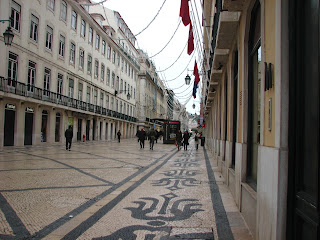 Shops stay closed, tourism on hold… And on the morning of 24th, the day turned warm and sunny in Mação. The rain clouds that had hung over the town took the day off. Definitely, there was not much Christmas in the air. By mid- afternoon, I had checked into a hostel near the Baixa Chiado metro station in Lisbon. For, who wants to feel lonely on the Christmas eve.
Miguel of the hostel warned me of starvation in the streets of Lisbon that night. So I signed up for the hostel dinner and set off to take the tram 28 E armed with a map and Miguel’s explicit instructions to get lost in the streets of Alfama. Unlike the interior districts of Portugal, Lisbon is well connected through a network of buses, metros trams and ferries.Trams were in operation in Lisbon from as far back as 1873. The horse drawn affairs of the bygone days have given way to yellow electric carriages. The last major restructuring took place in the 1990 s.
The carriage slowly made its way up through the narrow cobbled streets. At Graca, the driver kindly explained to me that it was as far as the tram would go and it would be convenient if I get out. So I decided to trace the tram line back on foot.
Alfama is the oldest district in Lisbon spreading from the castle of Lisbon to river Tejo. The name dates back to the Moorish times (Al- hamma), denoting baths. Alfama has retreated from its Moorish glory to be one of the poorest districts in Lisbon now. The streets of Alfama winds up and down in rather steep slopes and often you have to close your umbrella to allow a passing tram. I heard the frustrated tram driver yell her way through the cars that inched out of the side-streets unexpectedly. The streets are lined by old three storied structures that now house shops and restaurants (which were of course closed on the day!). By five o clock in the evening I was looking at Alfama from the Porta do sol (Gateway of the sun) as it sloped down to touch the banks of Tagus. Tagus, almost as expansive and alive as the ocean beyond. Alfama from here was a cluster of red roofs and white walls, so closely packed that the streets below are scarcely revealed.
I stepped into the dim lights of the Sè cathedral and saw the tableau of the divine birth set up there. At one of those rare coffee shops that was open, the owner told me of the choir where he was to sing at the night service. It’s a great thing to know a bit of the language. How else could I have made sense of anything the man said, as he talked about the notes of the carols and the charm of the Christmas lights and why he thought I should believe in something at the very least.
But there was more to the night than I had expected…

(cont…)
They say, Portugal draws into itself on Christmas.
Shops stay closed, tourism on hold… And on the morning of 24th, the day turned warm and sunny in Mação. The rain clouds that had hung over the town took the day off. Definitely, there was not much Christmas in the air. By mid- afternoon, I had checked into a hostel near the Baixa Chiado metro station in Lisbon. For, who wants to feel lonely on the Christmas eve.Miguel of the hostel warned me of starvation in the streets of Lisbon that night. So I signed up for the hostel dinner and set off to take the tram 28 E armed with a map and Miguel’s explicit instructions to get lost in the streets of Alfama. Unlike the interior districts of Portugal,
Lisbon is well connected through a network of buses, metros trams and ferries.Trams were in operation in Lisbon from as far back as 1873. The horse drawn affairs of the bygone days have given way to yellow electric carriages. The last major restructuring took place in the 1990 s. The carriage slowly made its way up through the narrow cobbled streets. At Graca, the driver kindly explained to me that it was as far as the tram would go and it would be convenient if I get out. So I decided to trace the tram line back on foot.
Alfama is the oldest district in Lisbon spreading from the castle of Lisbon to river Tejo. The name dates back to the Moorish times (Al- hamma), denoting baths. Alfama has retreated from its Moorish glory to be one of the poorest districts in Lisbon now. The streets of Alfama winds up and down in rather steep slopes and often you have to close your umbrella to allow a passing tram. I heard the frustrated tram driver yell her way through the cars that inched out of the side-streets unexpectedly. The streets are lined by old three storied structures that now house shops and restaurants (which were of course closed on the day!).
By five o clock in the evening I was looking at Alfama from the Porta do sol (Gateway of the sun) as it sloped down to touch the banks of Tagus. Tagus, almost as expansive and alive as the ocean beyond. Alfama from here was a cluster of red roofs and white walls, so closely packed that the streets below are scarcely revealed. I stepped into the dim lights of the Sè cathedral and saw the tableau of the divine birth set up there. At one of those rare coffee shops that was open, the owner told me of the choir where he was to sing at the night service. It’s a great thing to know a bit of the language. How else could I have made sense of anything the man said, as he talked about the notes of the carols and the charm of the Christmas lights and why he thought I should believe in something at the very least.
But there was more to the night than I had expected…
(cont…)
07 December 2010
To a winter in Europe
I felt as I always do, as I waited for my flight at the departure terminal of Delhi airport- that, I have already left. The moment you cross the imigration line, you lose your Delhi.But never so much as this time.In Delhi the winter had set in. Not too harsh, just so much that you want to huddle around in a tight group over cups of tea.Just so much that that cigarette lights are visible above the slight mist.It is the break in Delhi that always make leaving home easy. I had stepped out of the aircraft the evening before into the familiarity of the cool breeze on my face. And i wished that I could stay on.
The Delhi international airport has revamped itself since my last departure. It is posh and grand. The long walks to find your gate, matches any of the other airports that we hear of.I wait at my gate with European faces. I listen to the boarding announcement in the strage 'neutral'ised accent. (Colbe,that s where the trimmed accents go to!). The only sign of the nation outside are the portraits of young men and women in regional attire standing guard at the loo entrances. But then those are portraits for the foreign eyes.
So i sit there and think of things. Why is Delhi that was once so strange now almost home, almost as hard to leave? I wonder if I stayed on long enough,Europe would turn out to be just so.Well, I guess not. It is not that I do not have great friends there. I enjoy the travel. I am eager for more. This winter I am going to meet snow for the first time. In a few hours I would get a glimpse of Zurich as spread out among snowfolds.
But then, there is an odd formality to the life there. A set of rules which cannot be learned easily. Like paying only your tab at the restaurant.Individual space has so much value that I feel suffocated often. Once a couple of years back I was with a group of English students. They were all drinking gin and tonic from bottles they had brought but would not offer.I cried then (and mind you not just for the gin and tonic). Well it is'nt the rule.Already I am aquainted to a number of people to know that much. There is not a single Europe.
I think its worth spending time getting to know Europe.It is possible that each cent is not always to be accounted for.
But after that, I am going to come back..

The Delhi international airport has revamped itself since my last departure. It is posh and grand. The long walks to find your gate, matches any of the other airports that we hear of.I wait at my gate with European faces. I listen to the boarding announcement in the strage 'neutral'ised accent. (Colbe,that s where the trimmed accents go to!). The only sign of the nation outside are the portraits of young men and women in regional attire standing guard at the loo entrances. But then those are portraits for the foreign eyes.
So i sit there and think of things. Why is Delhi that was once so strange now almost home, almost as hard to leave? I wonder if I stayed on long enough,Europe would turn out to be just so.Well, I guess not. It is not that I do not have great friends there. I enjoy the travel. I am eager for more. This winter I am going to meet snow for the first time. In a few hours I would get a glimpse of Zurich as spread out among snowfolds.
But then, there is an odd formality to the life there. A set of rules which cannot be learned easily. Like paying only your tab at the restaurant.Individual space has so much value that I feel suffocated often. Once a couple of years back I was with a group of English students. They were all drinking gin and tonic from bottles they had brought but would not offer.I cried then (and mind you not just for the gin and tonic). Well it is'nt the rule.Already I am aquainted to a number of people to know that much. There is not a single Europe.
I think its worth spending time getting to know Europe.It is possible that each cent is not always to be accounted for.
But after that, I am going to come back..
Subscribe to:
Posts (Atom)